

We've spent three years building the world's best time-travel debugger for the past. Today, we're announcing something considerably more ambitious.
Replay Precog — deterministic debugging for bugs in code that doesn't exist yet.
The Problem With Debugging Today
Current debugging tools, including our own, share a fundamental limitation: they require the bug to have already happened. You write code. It ships. It breaks. You record. You replay. You find the root cause.
This is, frankly, embarrassing. We've built a time machine that only goes backwards.
Inspired by the 2002 documentary Minority Report, our research team asked a deceptively simple question: what if we could arrest the bug before it commits the crime?
How Precog Works
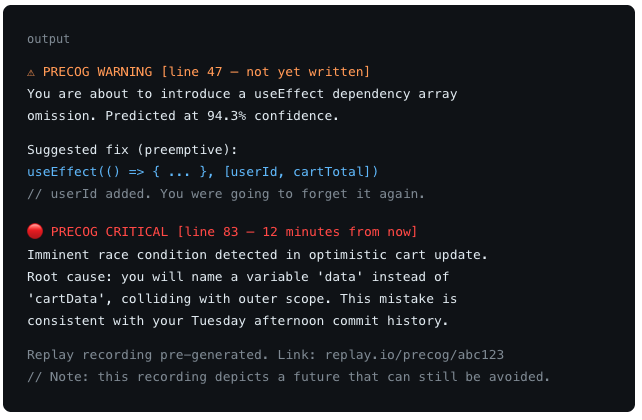
Precog is a new Replay MCP tool —
replay_precog_analyze — that integrates directly into your IDE. When you open a file, Precog begins analyzing the potential execution state of code you are currently typing.Under the hood, we're running a speculative React reconciler across a probabilistic AST shadow DOM — essentially, a ghost renderer that simulates what your component would do if you finished writing it, based on your typing velocity, variable naming conventions, and your personal Redux anti-pattern fingerprint.

The Pre-crime Dashboard
For teams, Precog ships with a new Pre-crime Dashboard — a real-time feed of bugs your engineers are statistically likely to introduce in the next 72 hours, ranked by predicted severity.
Engineering managers have described early access as "clarifying."
"I finally have data to back up what I've always suspected about our senior front-end engineer."— Series B fintech CTO, beta customer
We are not responsible for any personnel decisions made using Precog data.
Precog for Vibe-Coded Apps
Precog has a special operating mode for apps built with Lovable, Base44, Replit, and similar tools: Ambient Precog.
In this mode, there is no code to analyze — only vibes. Precog monitors the emotional state of the prompt author using keystroke cadence, sentence fragment length, and the ratio of exclamation points to question marks in your prompts. From this, it infers structural instability in the component tree before the component tree exists.
Ambient Precog's most-triggered warning, across all beta users:

Ethical Considerations
We consulted with legal on the implications of penalizing engineers for bugs they haven't written. Legal said this was "not their department." We consulted with our ethics board. We don't have an ethics board. We consulted with our investor. He said ship it.
There is, however, one hard constraint we've built in: Precog will never surface a prediction with less than 60% confidence. Below that threshold, it's not a bug — it's just software engineering.
Limitations (Current Beta)
- Precog cannot predict bugs introduced by other people's bad PRs landing in your branch. This is a known class of unpredictable chaos we call external state corruption and is philosophically outside our roadmap.
- TypeScript any renders Precog completely blind. This is intentional and we consider it a feature.
- Precog has no jurisdiction over CSS. No one does.
Availability
Replay Precog is available today for everyone.
To enable it, run:

Note: this command does nothing.
We do, however, actually build the best debugging tools in the world for bugs that have already happened.